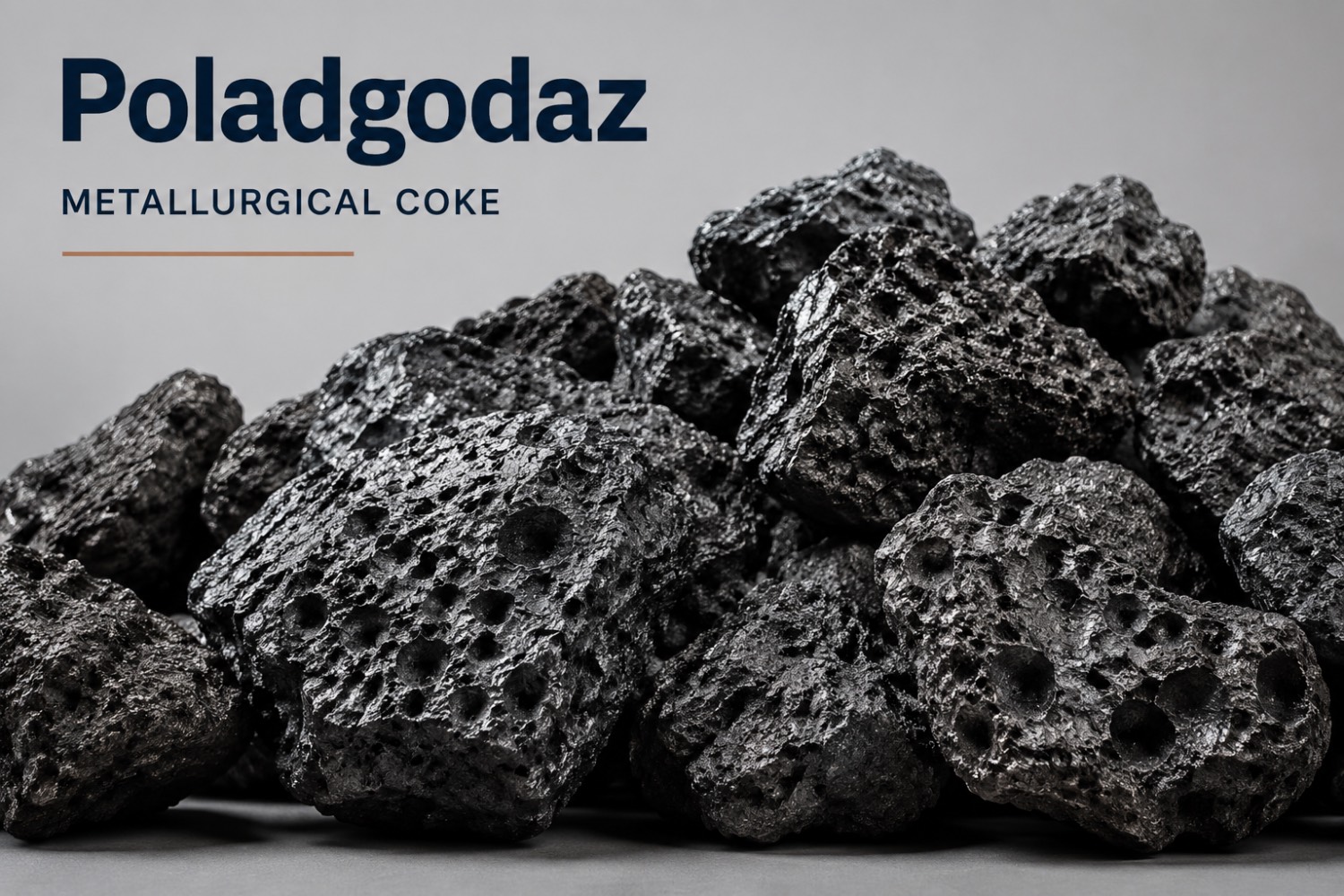
Suitable for Blast Furnaces
Metallurgical Coke
Metallurgical Coke is a key carbon-based material used in the steel and metallurgical industries. It serves as a fuel, reducing agent, and carbon source in iron and steel production processes. Poolad Godaz supplies Metallurgical Coke based on industrial customer requirements, with consideration of key specifications including chemical analysis, fixed carbon, ash, sulfur, moisture, CSR, CRI, strength, and particle size distribution. Product specifications, origin, particle size, and commercial terms can be evaluated and tailored according to the customer’s application and delivery requirements.
Product Overview
Metallurgical coke
Metallurgical coke is a material with high carbon and few impurities that is used as a fuel. Coke is a solid carbonate material that is obtained from low-ash and low-sulfur bituminous coals.
Coke obtained from coal is gray in color and is also hard and porous. Of course, coke also exists naturally, but the most commonly used coke is coke made from coal by man.
Special coals are used to produce metallurgical coke, and the properties of the coal determine the properties of the coke produced.
The presence of ash in coke increases the consumption of coke and limestone in the blast furnace and reduces the production capacity of coke batteries.
Metallurgical coke is a porous material that is used in blast furnaces and is one of the major uses of coke in the metallurgical industry.
Coke in a blast furnace has various roles in providing energy and reducing iron ores and creating porosity for the passage of reducing gases and carburizing cast iron. In a coupler furnace, coke is also used as a fuel and reducing agent. It should be noted that coke is also used in the foundry industry.
Coke contains a percentage of sulfur and phosphorus. As a result, the most important factor in the introduction of sulfur and phosphorus into the steel production process is coke. Sulfur and phosphorus are harmful elements in steels.
- Introduction to the coke-making process:
To reduce iron, an agent is needed that separates oxygen from iron oxides. This substance is called a reducing agent. All reactions in a blast furnace are carried out at high temperatures, which are the result of burning coke.
Coke obtained from coal is used for the reduction and melting process in the blast furnace. Natural gas and fuel oil are also used in small amounts instead of coke. Recent research has shown that the hydrogen reduction capability of natural gas is much greater than that of coke carbon.
Therefore, attempts are being made to inject natural gas into the blast furnace to produce hydrogen gas in the blast furnace by burning it. In modern blast furnaces, the method of injecting coal powder is also used, which greatly reduces coke consumption.
Because coking coal has low strength and high impurities (approximately 35%), it cannot meet all the necessary conditions as a blast furnace fuel
Therefore, it is converted into coke to meet the necessary conditions (sufficient strength, low percentage of impurities, and high calorific value) for charging in the blast furnace. Therefore, the changes that result from converting coal into coke are:
Increase in the carbon percentage and consequently increase in calorific value.
Increased resistance to mechanical factors such as impact, pressure, fall, and abrasion.
Reduction of volatile impurities resulting from the release of gases and volatile coal materials
Increased surface area for further combustion, which is provided by the porosity of coke.
Metallurgical coke
In addition to providing the necessary thermal energy in the blast furnace, coke also performs the reduction of iron oxides in iron ore. Reduction can be carried out directly by carbon (in front of the blast furnace forms) or CO2, H2 gas.
The calorific value of coke should be maximum and its moisture should be minimum. (The moisture content of coke depends on the duration of residence in the quenching towers and the amount of water absorbed by the coke.)
If the moisture content of coke is high, it has a negative effect on the operation of the blast furnace because it prevents the creation of a suitable thermal condition in the blast furnace and the efficiency of the furnace decreases.
Currently, the Isfahan Iron and Steel Works uses the wet method or spraying cold water on hot coke to quench coke, and the dry method (quenching with an inert gas, i.e. nitrogen) is not used.
Using the dry method, the moisture content of coke can be reduced and its strength increased, and of course, the energy of the gas blown into the coke can also be used.
Considering the above, the necessary conditions for coke consumed by the blast furnace are:
Its calorific value should not be less than 4000 kcal/kg.
Its sulfur content should not exceed 1%.
The coke must have sufficient strength.
Its ash content should not be less than 14%.
The moisture content in coke should be less than 9% and the coke grain size should be 5 to 80 mm. Usually, to melt one ton of pig iron, 450-500 kg of coke is required, and the price of this amount of coke is 30-50% of the price of one ton of pig iron.
The volatile matter should be less than 1%.
Request Quote & Specs
Complete the form below to receive a technical-commercial proposal.
Loading...
Key Applications
Features
Technical Specifications
Sample values; final specifications can be reviewed against customer requirements.
| Parameter | Unit | Typical |
|---|
Imagery & Process